
All Blogs articles
Over the past few weeks, the North Devon Coasts in Mind team has been working alongside a new group of young volunteers at Northam Burrows. Many of the group joined through our partnership with TTVS, a local charity that connects people with volunteering opportunities across Torridge.
The volunteers, mostly young adults with a shared curiosity about local history have been getting hands-on with the past, exploring the rich heritage of the coastline both indoors and out. Through these sessions, they’ve been developing new skills that not only bring history to life but also build confidence and experience that will support them in future studies, work, and community projects.
Exploring the Past, Building New Skills
Our first archive session took place at Northam Burrows, where volunteers delved into boxes of historic photographs, a real treasure trove capturing storms, local events, traditions, and the ever-changing landscape. While some of these images are already displayed in the Visitors’ Centre, others were exciting new discoveries unearthed by the group (Photo 1).

Photo 1: The group looking through the archives at Northam Burrows and recording important documents
After a short introduction to archive handling and recording, volunteers each selected a theme that caught their interest and began sifting through folder after folder of photographs. They learned how to become heritage detectives, identifying dates, spotting changes in the landscape, and photographing each image for the digital archive (Photo 2).

Photo 2: The volunteers learned to look for clues to date the photographs even if a date wasn't written on the record
It was inspiring to see everyone’s personal interests shine through. Some uncovered photos of events their parents or grandparents remember and now plan to record their stories to add a personal layer to the archive (Photo 3). Others, with a love of maps, tracked down the locations shown in the photos to compare how those places look today (Photo 4). One group even uncovered historic charts of sea defence plans that have long since been lost to the tides (Photos 5 and 6).

Photo 3: Volunteers were able to search online for additional information to them understand the photographs

Photo 4: A volunteer using Google Earth to identify where the photo was taken and what that area looks like now

Photo 5: Deciphering some old letters which discuss the Burrows

Photo 6: Some charts showing the sea defences for the Burrows, that were installed in the 1970s but which have long since washed away
Archaeological Recording Skills Sessions at Northam Burrows
During our outdoor session, volunteers joined a guided walk to explore some of the Second World War archaeological features scattered across the Northam Burrows landscape. Once an important military training ground and coastal defence site, the Burrows still hold traces of its wartime past, from practice trenches to defensive structures that have weathered decades of coastal change (Photo 7).

Photo 7: Some of the group out on Northam Burrows for a tour of some of the archaeological features dotted across the landscape
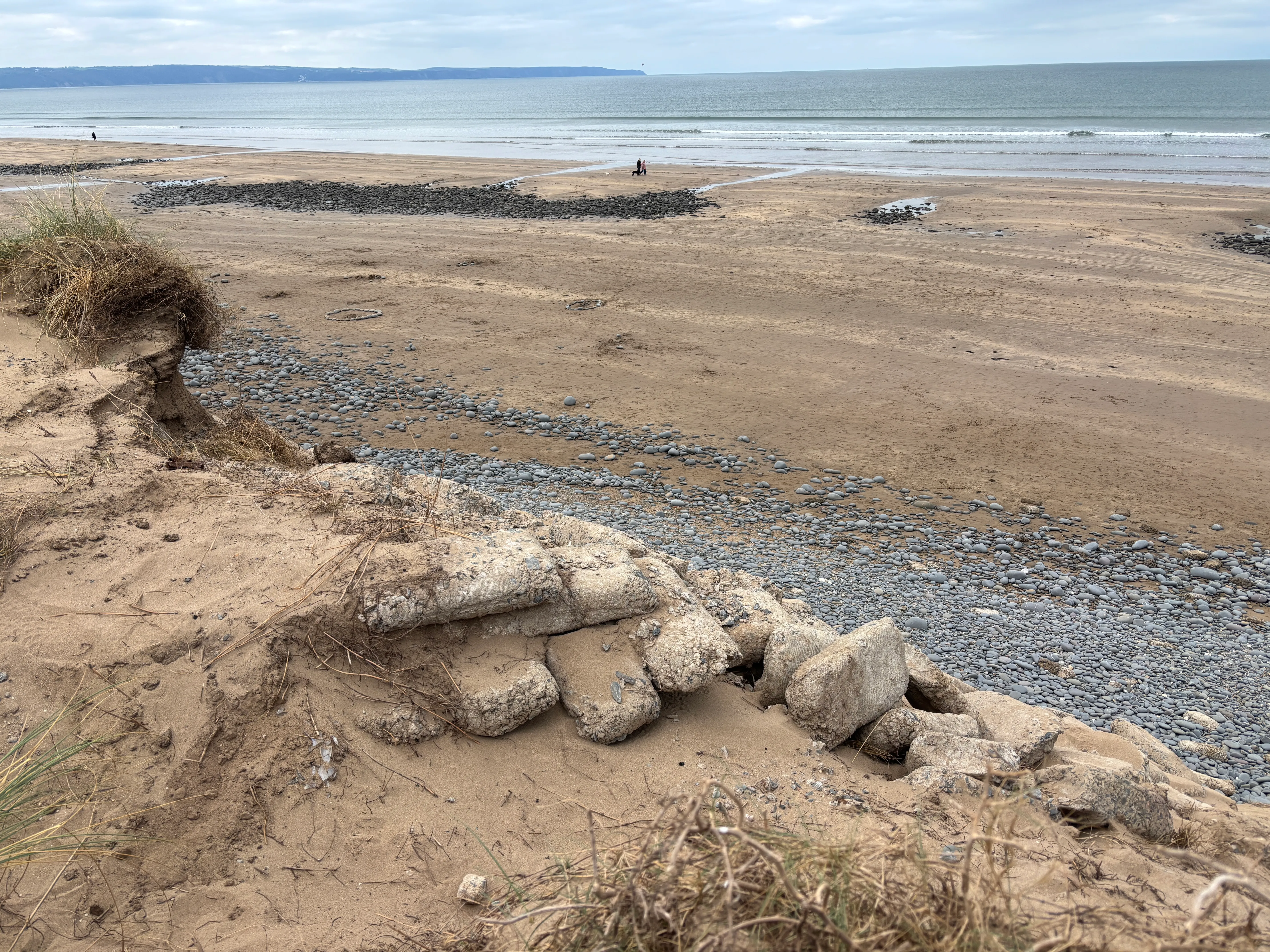
The group was particularly interested in a sandbag feature on the dunes, which is now eroding quickly. You can see both historic and recent images of this feature on the Coasts in Mind interactive map (Photo 8).

Photo 8: The group in front of the WW2 sandbags. These formed a fortified trench used by the military during the war. They have changed rapidly over the past few months as more and more sandbags erode out of the sand dune
Together, we discussed how to record and monitor this change. The volunteers came up with a plan to take regular photographs from fixed points, allowing us to track how the dunes and the sandbag feature evolve over time. Some of the group have already committed to capturing these images throughout the year so that we can create a visual timeline showing the feature’s gradual transformation (Photo 9).

Photo 9: A volunteer snapping a photo of the feature from one of the angles the group selected for monitoring
The Coasts in Mind team also demonstrated how to use a mobile photogrammetry app to create 3D models directly from photographs. The group practiced making a model of the sandbag feature and hope to build a full 3D reconstruction of the site in the future.
Finally, the volunteers set out to match the locations of some of the historic images they had uncovered in the archives. Using their new skills, they photographed the same views from the same angles, creating powerful “then and now” comparisons that show just how much the Burrows have changed over time (Photo 10).

Photo 10: The group deciding on angles to use for photographic monitoring of the top of the concrete sandbag feature
Volunteer Feedback
The volunteers have thoroughly enjoyed taking part in the sessions, with many returning each week eager to learn more and contribute to the project.
One volunteer, Emma, shared her thoughts on the experience:
“I am interested in the project because I have a strong interest in local history and appreciate the opportunity to explore and hopefully preserve it. In our sessions we have studied different types of records from the archives, for example my group came across aerial photographs of Westward Ho! showing how much change there has been in this area in the decades since the photos were taken.
We also came across an old Devonshire folk poem, which was of interest to me because I feel North Devon has a unique culture that is as important to preserve as the physical aspects of the area.
It would be great to access the archives again, to look at more records and learn more about the history of the area. I also appreciated the opportunity last week to physically explore and learn more about the techniques you use as archaeologists.”
Kayleigh, another volunteer, said that
“looking at the archives such as the photos of the snowstorm in the 80s and photos from the second world war is amazing. To think how many different minds (human and animal) and situations have been on this beautiful piece of land is really humbling on my evening walks. I'm very grateful to live in such a wonderful location and to have the opportunity to take part in this project!”
Emma and Kayleigh’s words capture what Coasts in Mind is all about: creating opportunities for people to connect with their local heritage, discover new skills, and contribute to the stories that shape the North Devon coastline. The enthusiasm and curiosity shown by the volunteers highlight how engaging with history can build not just knowledge, but confidence, connection, and pride in place.
Future Plans
Over the coming weeks, the group will continue their fantastic work exploring and recording the heritage of Northam Burrows. Volunteers are being trained to upload their findings to the Coasts in Mind online mapping platform, adding the photos and documents they’ve uncovered, along with their own site photographs from around the Burrows. You can see some of the records they have added to the map here:
https://cim.mola.org.uk/map/records/a-friendly-game-at-northam-burrows-in-the-old-days
https://cim.mola.org.uk/map/records/potwallopers-1926
https://cim.mola.org.uk/map/records/frozen-foam-on-the-beach-at-westward-ho
https://cim.mola.org.uk/map/records/work-on-the-pebble-ridge
As the project progresses, the volunteers will begin to put their new skills into practice by researching topics of personal interest, both at Northam Burrows and in local museums. They’ll have the chance to search for photographs and records connected to their chosen themes while developing valuable archive and research skills using primary sources.
We are thrilled to be working with such an enthusiastic and talented group, and we can’t wait to see what fascinating discoveries they make next.
Call to Action
Would you like to get involved and learn photogrammetry, monitoring, and archive skills? Get in touch to join our next session or keep an eye on the Coasts in Mind interactive map to see the new data points our volunteers are adding!